
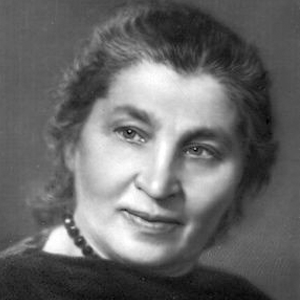
A multi-faceted Yiddish writer, Shira Gorshman (who also wrote under the names Shirke Goman, Shire Gorman and Szyrke Gorszman) embodied the vision and struggles of Jewish socialism throughout her long and productive life. She was a passionate and tireless participant in the major social movements of the twentieth century and bore witness in her memoirs and fiction to all their configurations and manifestations.
Gorshman was born in Krok (Krakes), a small town near Kovno (Kaunas), Lithuania to a poor and troubled family. Her father divorced her mother when Shira was an infant because he wanted to become a full-time scholar and could not achieve that status while supporting a family. During World War I the family was evacuated to Odessa where Shira finished elementary school. Forced by her stepfather’s cruelty to leave her mother’s house at the age of fourteen, she found a haven with her beloved grandfather who taught her Tanakh (the Hebrew Bible). While still in her teens, she became a Zionist, married, gave birth to her first daughter and in 1924 immigrated to Palestine, joining the agricultural collective Gedud ha-Avodah Trumpeldor near Jerusalem. In 1929, following an ideological split, Gorshman, now divorced, returned to the Soviet Union with her three daughters to participate in the development of Jewish agricultural collectives in the Crimea. They lived for three years in the collective, where she managed its dairy farm operation. There she met her second husband, Mendel Gorshman, a visiting graphic artist (who subsequently illustrated several of Shira’s books). In the 1930s they moved to Moscow, where her life brought her into a circle of artists and writers.
Her entry into the world of literature was delayed by her socialist conviction that Jews should work at ordinary labor and not exempt themselves as writers, artists and academics. Although she began writing at an early age, she did not write seriously until the late 1930s in Moscow, and then only at night while her children slept. In 1937, when the poet Leib Kvitko (1890–1952) saw her unpublished short story “Der Mitesser” (The Fellow-Eater), a mother’s tragic account of brutal poverty, he exclaimed she had earned a place in Yiddish literature on the strength of that story alone. Gorshman included “Der Mitesser” in several collections: 33 Novelen (Warsaw, 1961) and Oysdoyer (Endurance) (Tel Aviv, 1992). Her stories began to appear in journals: Der shtern (Kiev); Der emes (Moscow) and Eynikayt (Moscow) and were included in the anthologies, Tsum zig (Towards Victory, 1944) and Heymland (1947). One of her daughters died of starvation in Moscow during World War II.
On her return to Israel in 1990 after an absence of sixty years, Gorshman was embraced by the Yiddish literary establishment. Awarded literary prizes and writing grants including the Dovid Hofshteyn Prize and the Fund for Yiddish Production in Israel, she continued with her prolific creativity well into old age. In Israel she found the freedom and support to recapture the past, including those events she had self-censored in her writing during the years in Russia. Khane’s shuf un rinder (Chana’s Sheep and Cattle), published in 1993, is an unembellished, largely autobiographical novel of collective life in Crimea in the early thirties and of the selfless young idealists who struggled to create a just world beyond the national boundaries of Palestine.
In the memoir In di shpurn fun gedud ha-avodah (In the Wake of the Gedud ha-Avodah, 1988), Gorshman retraces their communal life in Palestine and the Crimea. On a gal (Without Gall), a book of stories, sketches and reminiscences, is a recapitulation: her life with her grandfather, her former communalists, artist and writer friends. This collection, published in 1996, also contains heartfelt tributes to her Israeli editors. Never one to slip into smugness, Gorshman speaks tenderly but critically of her neighbors in the seniors’ residence in Ashkelon where she lived with one of her daughters.
Women’s experience and perspective are central to the terrain Gorshman covered: She depicted both particular and universal social transformations in her/their lives with compassion and keen psychological insight. Integrating historical and personal chronology, her work encompassed the shtetl of Lithuania, pioneering Palestine, the Soviet experiment, the Holocaust and finally the return to modern Israel. In all these journeys her characters—the mothers, toilers, writers, artists—are revealed in their full humanity and individuality.
Gorshman’s traditional Yiddish is weighted with Jewish and worldly sources: Isaac Leib Peretz (1852–1915), Chekhov and De Maupassant were her literary influences. Her voice, always authentic, is alternately sharp, lyrical, playful, unpretentious. Mirroring the spoken word, her fictive dialogue is vivid, witty, direct. Rare in Yiddish writing: a woman’s capacious life delineated both in the literature of memory and imagination, a reflective and reflected life, lived on the margins and in the center of world-shaping events.
Shira Gorshman died on April 6, 2001 in Ashkelon, Israel.
Der koyakh fun lebn: noveln un geshtaltn ( The Strength of Life: Novellas and Portraits). Moscow: 1948; 33 Noveln Warsaw: 1961.
Lebn un licht: dertseylungen un noveln (Life and Light: Stories and Novellas). Moscow: 1974.
Yontev in mitn vokh: roman, dertseylungen, noveln un rayze bilder (A Holiday in Midweek: A Novel, Short Stories, Novellas, and Travel Scenes). Moscow: 1984.
Oysdoyer: dertzeylungen, noveln, zikhroynes (Survival: Short Stories, Novellas, Reminiscences). Tel Aviv: 1992.
Khanes shof un rinder: roman (Chana’s Sheep and Cattle: A Novel). Tel Aviv: 1993.
Vi tsum ershten mol: novele, dertsylungen, skitzen (Like the First Time: Novella, Short Stories, Sketches), illustrated by Mendel Gorshman. Tel Aviv: 1995.
On a gal: dertsaylungen, skitsen, zikhroynes (Without Gall: Short Stories, Sketches, Reminiscences). Tel Aviv: 1996.
In di shpurn fun “Gedud ha-Avodah” (In the Wake of the “Gedud ha-Avodah”). Tel Aviv: 1998.
“Unspoken Hearts.” In Found Treasures: Stories by Yiddish Women Writers, edited by Frieda Forman et al. Toronto: 1994.
Secondary Sources
Leksikon fun der nayer Yidisher literatur. New York: 1958.
Interview with the author. Ashkelon: January 2, 1995.
Fishkoff, Sue. “A female perspective on shtetl, kibbutz life” (Report on interview with Gorshman and Forman). The Jerusalem Post, January 20, 1995: 14.
Obituary: Forverts, April 13, 2001.
12 thoughts on “Kaminos”
Was Nicholas related to Alexander Saslavsky who married Celeste Izolee Todd?
Anyone have a contact email for Yair Klinger or link to score for Ha-Bayta?
wish to have homeland concert video played on the big screen throughout North America.
can organize here in Santa Barbara California.
contacts for this needed and any ideas or suggestions welcomed.
Nat farber is my great grandpa 😊
Are there any movies or photos of max kletter? His wife’s sister was my stepmother, so I’m interested in seeing them and sharing them with his wife’s daughter.
The article says Sheb recorded his last song just 4 days before he died, but does not tell us the name of it. I be curious what it was. I’d like to hear it.
Would anyone happen to know where I can find a copy of the sheet music for a Gil Aldema Choral (SATB) arrangement for Naomi Shemer’s “Sheleg Al Iri”. (Snow on my Village)?
Joseph Smith
Kol Ram Community Choir, NYC
Shalom Joseph. I just saw your 2024 post by chance… I’m a mostly-retired Israeli journalist and translator. In 2003 I translated into English the content (the objective was to remain true to the meaning, not to cadence or rhyme) of poems and lyrics of 48 of Israel’s most iconic songs arranged by Aldema for choirs abroad singing in Hebrew (the words in the scores are transliterated) but members of the choir lack mastery of Hebrew to ‘know’ exactly what they are saying/singing… The book was titled in English “A Merry Choir” – in Hebrew מקהלה עליזה . See if you can find a copy in a used book store, it is priceless and apparently out-of-print – well worth the search. If not, they may have a copy at Tel Aviv Amenu Museum’s music department – write them and see if they can send it to you. Or – if you will contact me via Whatsapp – (972) 546872768 or via my email – I will try and find the book (it is not where it ‘should be’ so I have to search) and I will photograph the score with my cell and send to you as an attachment. Best, Daniella Ashkenazy – Kfar Warburg.
שלום שמעון!
לא שכחתי אותך. עזבתי את ישראל בפברואר 1998 כדי להביא את בני האוטיסט לקבל את העזרה המקצועית שלא הייתה קיימת אז בישראל. זה סיפור מאוד עצוב וטרגי, אבל אני הייתי היחיד עם ביצים שהביא אותו והייתי הורה יחיד בשבילו במשך חמישה חודשים. הוא היה אז בן 9. כעת הוא בן 36 ומתפקד באופן עצמאי. נתתי לו הזדמנות לעתיד נורמלי. בטח, אבות כולם חרא, אומרים הפמינציות, אבל כולם צריכים לעבוד כמטרות במטווחי רובה!
משה קונג
(Maurice King)
Thank you for this wonderful remembrance of Herman Zalis. My late father, Henry Wahrman, was one of his students. Note the correct spelling of his name for future reference. Thank you again for sharing this.
Tirza Wahrman (Mitlak)
amazing zchuso yagein aleinu, he wrote the famous niggun Lefichuch that is sung in almost every Israeli Yeshiva
My grandmother, Rose Ziperson, wrote the words to his music for a song called Main Shtetele, which he produced. I have the sheet music!