
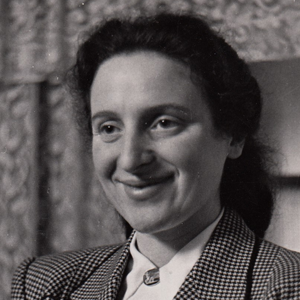
Chava Rosenfarb was born on Feb. 9, 1923 in Lodz, Poland, the elder of two daughters of Abraham Rosenfarb, a restaurant waiter, and his wife Simma. Her parents belonged to the Jewish Socialist Bund, a left-leaning political movement with an enormous following among working-class Jews in Poland. While Bundist ideology encouraged agitation for equal rights for Jews in Poland, but it also incorporated a strong cultural element that privileged Yiddish as the language of the Jewish masses.
Rosenfarb’s parents sent her to the Bundist Medem School, where all instruction was in Yiddish. This grounding in Yiddish secular studies had an enormous influence on Rosenfarb’s intellectual development, even though her secondary school education was in Polish. But her schooling was cut short by the war. By the time she was ready to graduate high school, Rosenfarb and her family had been incarcerated in the Lodz ghetto, and it was in the ghetto in 1941 that she received her high school diploma. This marked the end of her formal education.
In the ghetto she began to write poetry, waking up at dawn from her bed of chairs to compose her poems in bookkeeping registers in the hours before going to work at her various ghetto jobs. Despite her modest appraisal of herself as “just a girl who wrote poems,” Rosenfarb’s talent brought her to the attention of Simcha-Bunim Shayevitch, the great ghetto poet and author of the epic poem “Lekh Lekho.” She became Shayevitch’s protegée and it was he who introduced her to the writers’ group of the Lodz ghetto, who quickly recognized her talent and accepted her, at age seventeen, as their youngest member.
When it became clear that the Lodz ghetto was to be liquidated in August of 1944, Rosenfarb and her family, as well as Shayevitch and the family of Henekh (later anglicized to Henry) Morgentaler, the man who would become her husband, as well as the family of Chava’s best friend, who would later become the Swedish writer, Zenia Larsson, all hid in the second room of the Rosenfarbs’ ghetto apartment behind a door that was hidden by a wardrobe. They were discovered by the Nazis two days later, on August 23, 1944, and deported to Auschwitz. At Auschwitz the knapsack containing Rosenfarb’s poems was ripped out of her hands and thrown on a pile to be discarded. During the selection for life or death, Rosenfarb claimed that her mother was in reality her elder sister and in this way she managed to save her mother’s life. From Auschwitz, Rosenfarb, her mother and sister were sent to a labour camp at Sasel where they were put to work building houses for the bombed out Germans of Hamburg.
From Sasel, the three women were sent to Bergen Belsen. There Rosenfarb contracted typhus and on the very day when the British army liberated the camp in 1945, she was lying near death. The British transported her to a lazaret outside the camp, where she slowly recovered. Once she regained her strength, Rosenfarb and her sister traveled the German countryside seeking news of their father, whom they had last seen at the train station in Auschwitz. After weeks of fruitless searching, Rosenfarb learned that her father had died in the last transport out of Dachau, when the train on which he and the other inmates had been riding was bombed by the Americans. In 1945, Rosenfarb, her mother and sister crossed the border illegally into Belgium, where she lived as a Displaced Person, supporting herself as a teacher at the Workman’s Circle Yiddish school. It was in Brussels too that she began to write The Tree of Life. Because she had no legal standing in Belgium she was required to emigrate. In 1949, she married Heniek Morgentaler and the two emigrated to Canada, landing in Montreal in February 1950. There she gave birth to her first child, a daughter Goldie, several months after her arrival in the New World.
In Canada, Rosenfarb quickly settled down to write. She began as a poet, publishing her first collection of poetry, Di balade fun nekhtikn vald [The ballad of yesterday’s forest] in London in 1947. This was followed by a book-length poem about her father, Dos lid fun yidishn kelner Abram [The song of the Jewish waiter Abram]; and the poetry collections Geto un andere lider [Ghetto and other poems] and Aroys fun gan-eydn [Out of Paradise]. Her play Der foigl fun geto [The bird of the ghetto], about the martyrdom of the Vilna ghetto partisan leader, Isaac Wittenberg, was translated into Hebrew and performed by the Habimah, Israel’s National Theatre, in 1966.
Finding that neither poetry nor drama could begin to express the range and depth of her feelings about the Holocaust, Rosenfarb turned to fiction. In 1972, she published in Yiddish Der boim fun lebn [The Tree of Life]. This monumental three-volume epic chronicles the destruction of the Jewish community of Lodz during the Second World War. It is one of the few novels—as opposed to memoirs or autobiographies—to be written by an actual survivor of the Holocaust.
The Tree of Life follows the fates of ten Jewish inhabitants of Lodz who live through the terrible events of the years 1939-44, that is, from before the beginning of the war, when life was still “normal,” until the liquidation of the ghetto in August and September 1944. While most of Rosenfarb’s characters are fictitious, some are based on actual people, like the poet Shayevitch and Mordechai Chaim Rumkowski, the “eldest” of the Jews in the Lodz ghetto, put in place by the Nazis as the ghetto’s puppet leader.
The Tree of Life was immediately hailed as a masterpiece by the Yiddish press, which repeatedly emphasizing its unique place in the literature of the Holocaust. It earned Rosenfarb prizes and kudos in lands as diverse as Argentina, Mexico and Australia, to say nothing of the US, Canada and Israel. These included the Niger Prize from Argentina, the Atran Prize from the United States and the Canadian Segal Prize, which she won twice. In 1979, Rosenfarb was unanimously awarded one of Israel’s highest literary honours, the Manger Prize for 1979. The jury wrote: “[The Tree of Life] is a work that rises to the heights of the great creations in world literature and towers powerfully over the Jewish literature of the Holocaust, the literature which deals with the annihilation of European Jewry, in particular Polish Jewry.”
The Tree of Life was translated into Hebrew as Ets Hahayim and a one-volume edition appeared in English in Melbourne, Australia in 1985 and was later re-issued in its original three volumes by the The University of Wisconsin Press, (2004-6).
Rosenfarb followed The Tree of Life with the two-volume novel Bociany in 1982, named after an imaginary Polish village. Bociany, based loosely on the lives of Rosenfarb’s parents, follows the intertwined fates of a young boy and girl from the shtetl of Bociany who meet again as young adults in the city of Lodz, where they marry. Bociany was translated into English by the author herself and published in two volumes as Bociany and Of Lodz and Love. The translations won for Rosenfarb the John Glassco Prize of the Literary Translation Association of Canada in Sept. 2000. While these novels do not deal directly with the Holocaust, they actually constitute a prequel to The Tree of Life, giving the early history of some of the characters who appear in that novel.
Rosenfarb had always been reluctant to write about the horrors of the concentration camp in her fiction. She purposely ended The Tree of Life at the point where her characters were deported from the ghetto. The last few pages of The Tree of Life are thus purposely left blank. It was not until 1992 that Rosenfarb attempted to write a description of the camps in her novel Briv tsu Abrashn [Letters to Abrasha], which is, as yet, unpublished in English. The story is told through a series of letters written after the war by Miriam, a Holocaust survivor, to a man (Abrasha) who is lying in a sanatorium in Germany recovering from tuberculosis. In the letters Miriam recounts the events of her incarceration in Auschwitz, Sasel and Bergen Belsen where she was liberated.
Rosenfarb was a frequent contributor of essays, travelogues and stories to the Yiddish literary journal Di goldene keyt [The golden chain]. During the 1980s, she published there a series of short stories that explored the afterlife of Holocaust survivors in Canada. Several of these stories were translated into English by Goldie Morgentaler and published by Cormorant Press in 2004 in a single volume called Survivors: Seven Short Stories. This volume won the Helen and Stan Vine Canadian Jewish Book Award in 2005 and, in 2006, the Fenia and Yaakov Leviant Memorial Prize in Yiddish Studies, an Modern Language Association Book Award.
As long as the number of Yiddish readers world-wide remained relatively strong, the reception for Rosenfarb’s work was extremely favourable. But with the slow demise of a Yiddish readership, the imperative to publish in translation grew stronger. And this has proved much more difficult. Respected and lauded as she was among the international community of Yiddish readers and writers, in the rest of the world, Rosenfarb’s work is not well known. With the exception of the occasional poem or story published in translation in a literary journal, Rosenfarb’s work was not available in English in North America until 2000 when Syracuse University Press, published Bociany as two separate novels Bociany and Of Lodz and Love. Interest in Rosenfarb’s work got another boost thanks to a two-part documentary hosted by the journalist Elaine Kalman Naves for the CBC radio program “Ideas.” The program, which first aired in November 2000, was rebroadcast several times.
Rosenfarb had two children with Henry Morgentaler, a daughter Goldie and a son, Abraham. When her marriage to him ended in divorce, she became the common-law wife of Simkha-Binem (Bono) Wiener, whom she had known from her school days in Lodz. After the war, Wiener had settled in Melbourne, Australia and become part-owner of the Astronaut Travel Agency there. From the mid-1970s until Wiener’s death in Montreal in 1995, Rosenfarb and Wiener lived part of the year in Montreal and the other part in Melbourne. In 1998, she moved to Toronto and in 2003 she moved to Lethbridge, Alberta, to be near her daughter Goldie. In 2006, the University of Lethbridge bestowed on Rosenfarb her first university degree, a doctor of laws honoris causa, making her the first Yiddish writer to be honoured in this way by a Canadian university.
Chava Rosenfarb died January 30, 2011. Her archive can be found at the Thomas Fisher Rare Book Library of the University of Toronto.
Goldie Morgentaler
12 thoughts on “Kaminos”
Was Nicholas related to Alexander Saslavsky who married Celeste Izolee Todd?
Anyone have a contact email for Yair Klinger or link to score for Ha-Bayta?
wish to have homeland concert video played on the big screen throughout North America.
can organize here in Santa Barbara California.
contacts for this needed and any ideas or suggestions welcomed.
Nat farber is my great grandpa 😊
Are there any movies or photos of max kletter? His wife’s sister was my stepmother, so I’m interested in seeing them and sharing them with his wife’s daughter.
The article says Sheb recorded his last song just 4 days before he died, but does not tell us the name of it. I be curious what it was. I’d like to hear it.
Would anyone happen to know where I can find a copy of the sheet music for a Gil Aldema Choral (SATB) arrangement for Naomi Shemer’s “Sheleg Al Iri”. (Snow on my Village)?
Joseph Smith
Kol Ram Community Choir, NYC
Shalom Joseph. I just saw your 2024 post by chance… I’m a mostly-retired Israeli journalist and translator. In 2003 I translated into English the content (the objective was to remain true to the meaning, not to cadence or rhyme) of poems and lyrics of 48 of Israel’s most iconic songs arranged by Aldema for choirs abroad singing in Hebrew (the words in the scores are transliterated) but members of the choir lack mastery of Hebrew to ‘know’ exactly what they are saying/singing… The book was titled in English “A Merry Choir” – in Hebrew מקהלה עליזה . See if you can find a copy in a used book store, it is priceless and apparently out-of-print – well worth the search. If not, they may have a copy at Tel Aviv Amenu Museum’s music department – write them and see if they can send it to you. Or – if you will contact me via Whatsapp – (972) 546872768 or via my email – I will try and find the book (it is not where it ‘should be’ so I have to search) and I will photograph the score with my cell and send to you as an attachment. Best, Daniella Ashkenazy – Kfar Warburg.
שלום שמעון!
לא שכחתי אותך. עזבתי את ישראל בפברואר 1998 כדי להביא את בני האוטיסט לקבל את העזרה המקצועית שלא הייתה קיימת אז בישראל. זה סיפור מאוד עצוב וטרגי, אבל אני הייתי היחיד עם ביצים שהביא אותו והייתי הורה יחיד בשבילו במשך חמישה חודשים. הוא היה אז בן 9. כעת הוא בן 36 ומתפקד באופן עצמאי. נתתי לו הזדמנות לעתיד נורמלי. בטח, אבות כולם חרא, אומרים הפמינציות, אבל כולם צריכים לעבוד כמטרות במטווחי רובה!
משה קונג
(Maurice King)
Thank you for this wonderful remembrance of Herman Zalis. My late father, Henry Wahrman, was one of his students. Note the correct spelling of his name for future reference. Thank you again for sharing this.
Tirza Wahrman (Mitlak)
amazing zchuso yagein aleinu, he wrote the famous niggun Lefichuch that is sung in almost every Israeli Yeshiva
My grandmother, Rose Ziperson, wrote the words to his music for a song called Main Shtetele, which he produced. I have the sheet music!