
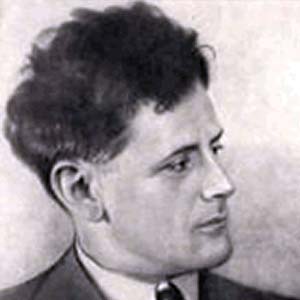
Peretz Markish was born in 1895 in Polonne, the Russian Empire (now Ukraine) to a Sephardi Jewish family. As a child he attended a cheder and sang in the choir of the local synagogue. He served as a private in the Russian Imperial Army during World War I. He was discharged from the army after the Russian Revolution, and settled in Ekaterinoslav (now Dnipropetrovsk), Ukraine. In 1918, he relocated to Kiev.
Markish’s first poetry collection, Shveln (“Thresholds”), published in Kiev in 1919, established his reputation. His poetry cycle Di kupe (“The Heap”; 1921) was written in response to the Ukrainian pogroms of 1919–20.
In the early 1920s, he was a member of the Kiev group of Yiddish poets that included David Hofstein and Leib Kvitko. After a series of pogroms took place in Ukraine, he moved to Warsaw and in Western Europe. While in Warsaw, he co-edited with I. J. Singer the expressionist literary anthology Khalyastre (“Gang”; 1922). Uri Zvi Grinberg and Melech Ravitch edited other literary publications. A second and final volume of Khalyastre, edited with Oser Varshawski, appeared in Paris in 1924 with a cover illustration by Marc Chagall. In 1924 he was a co-founder and editor of the Literarishe bleter in Warsaw.
In 1926, Markish returned to the Soviet Union. There he published a number of optimistic poems glorifying the communist regime, including Mayn dor (“My Generation”; 1927) and the epic Brider (“Brothers”; 1929). His novel Dor oys, dor ayn (“Generation After Generation”; 1929), about the genesis of revolution in a small Jewish town, was condemned for “Jewish chauvinism.” He was awarded the Order of Lenin in 1939. Markish joined the Soviet Communist party in 1942.
In April 1942, Stalin ordered the formation of the Jewish Anti-Fascist Committee designed to influence international public opinion and organize political and material support for the Soviet fight against Nazi Germany, particularly from the West. Solomon Mikhoels, the popular actor and director of the Moscow State Jewish Theater, was appointed the JAC chairman. Members of JAC included Der Nister, Itzik Feffer, Peretz Markish and Samuel Halkin. They wrote texts and petitions as cries for help against the Nazi pogroms. Among others, the texts were printed in U.S. newspapers. The JAC also raised funds.
In 1946, he was awarded the Stalin Prize, and wrote several paeans to Joseph Stalin, including a 20,000-line epic poem Milkhome (“War”) in 1948.
However, Stalin soon changed policy towards the liquidation of the Jewish Anti-Fascist Committee and against the remnants of official Jewish cultural activity in the Soviet Union. Solomon Mikhoels was murdered by the secret police in January 1948, to avoid a show trial. Other writers were accused of treason, and other “crimes”, and arrested. Markish was accused of being a “Jewish nationalist”, and arrested in January 1949, and shot with other Jewish writers during the Night of the Murdered Poets in August 1952.
After Stalin’s death, Markish’s widow Esther and his sons, literary scholar Shimon Markish and prose writer David Markish, actively set out to redeem his memory. Following Markish’s official rehabilitation in November 1955, several comprehensive editions of his poems, translated into Russian by Anna Akhmatova, were published in 1957. His oldest child, daughter Olga Rapay-Markish by his first wife, Zinaida Joffe, was a renowned Ukrainian ceramicist.
Markish wrote a number of poems and plays, as well as several novels.
Markish is one of the three heroes, with his fellow Yiddish poets Uri Zvi Grinberg (1896–1981) and Melekh Ravitsh (1893–1976), of Gilles Rozier’s novel D’un pays sans amour.
12 thoughts on “Kaminos”
Was Nicholas related to Alexander Saslavsky who married Celeste Izolee Todd?
Anyone have a contact email for Yair Klinger or link to score for Ha-Bayta?
wish to have homeland concert video played on the big screen throughout North America.
can organize here in Santa Barbara California.
contacts for this needed and any ideas or suggestions welcomed.
Nat farber is my great grandpa 😊
Are there any movies or photos of max kletter? His wife’s sister was my stepmother, so I’m interested in seeing them and sharing them with his wife’s daughter.
The article says Sheb recorded his last song just 4 days before he died, but does not tell us the name of it. I be curious what it was. I’d like to hear it.
Would anyone happen to know where I can find a copy of the sheet music for a Gil Aldema Choral (SATB) arrangement for Naomi Shemer’s “Sheleg Al Iri”. (Snow on my Village)?
Joseph Smith
Kol Ram Community Choir, NYC
Shalom Joseph. I just saw your 2024 post by chance… I’m a mostly-retired Israeli journalist and translator. In 2003 I translated into English the content (the objective was to remain true to the meaning, not to cadence or rhyme) of poems and lyrics of 48 of Israel’s most iconic songs arranged by Aldema for choirs abroad singing in Hebrew (the words in the scores are transliterated) but members of the choir lack mastery of Hebrew to ‘know’ exactly what they are saying/singing… The book was titled in English “A Merry Choir” – in Hebrew מקהלה עליזה . See if you can find a copy in a used book store, it is priceless and apparently out-of-print – well worth the search. If not, they may have a copy at Tel Aviv Amenu Museum’s music department – write them and see if they can send it to you. Or – if you will contact me via Whatsapp – (972) 546872768 or via my email – I will try and find the book (it is not where it ‘should be’ so I have to search) and I will photograph the score with my cell and send to you as an attachment. Best, Daniella Ashkenazy – Kfar Warburg.
שלום שמעון!
לא שכחתי אותך. עזבתי את ישראל בפברואר 1998 כדי להביא את בני האוטיסט לקבל את העזרה המקצועית שלא הייתה קיימת אז בישראל. זה סיפור מאוד עצוב וטרגי, אבל אני הייתי היחיד עם ביצים שהביא אותו והייתי הורה יחיד בשבילו במשך חמישה חודשים. הוא היה אז בן 9. כעת הוא בן 36 ומתפקד באופן עצמאי. נתתי לו הזדמנות לעתיד נורמלי. בטח, אבות כולם חרא, אומרים הפמינציות, אבל כולם צריכים לעבוד כמטרות במטווחי רובה!
משה קונג
(Maurice King)
Thank you for this wonderful remembrance of Herman Zalis. My late father, Henry Wahrman, was one of his students. Note the correct spelling of his name for future reference. Thank you again for sharing this.
Tirza Wahrman (Mitlak)
amazing zchuso yagein aleinu, he wrote the famous niggun Lefichuch that is sung in almost every Israeli Yeshiva
My grandmother, Rose Ziperson, wrote the words to his music for a song called Main Shtetele, which he produced. I have the sheet music!