
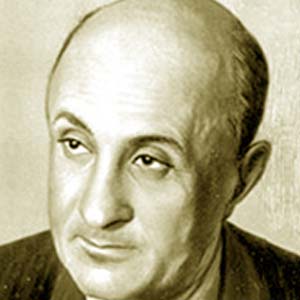
Yiddish poet. Born in Korostyshev, not far from Kiev, Dovid Hofshteyn was educated at a heder and by private teachers in Russian and Hebrew. His father, a forester, was a maskil; his mother came from the Pedotser-Kholodenko family of klezmer celebrities; and his sister, Shifra Kholodenko (1909–1974), was a noted Soviet Yiddish poet. Hofshteyn began writing poems at age nine, initially mostly in Hebrew, Russian, and Ukrainian, and his cultural experience in these languages influenced his Yiddish poetry.
At age 17, Hofshteyn became a private teacher and later studied at Kiev’s Commerce Institute. He welcomed the Bolshevik Revolution, and his Communist sympathies became even stronger after the heroic death of his cousin, Osher Shvartsman, a Red Army volunteer who was later canonized as the founder of Soviet Yiddish poetry. From 1917, when Hofshteyn’s poems began appearing in Kiev’s Yiddish periodicals, he occupied a prominent position in that language’s literary circles, particularly of the Kultur-lige. Although his first book, Bay vegn (At the Road), did not appear until 1919 (its enlarged edition was published in 1924 in Vilna), Hofshteyn soon had a following among aspiring poets.
In 1921, Perets Markish wrote about Yiddish literature’s successful “leap forward”—from the sentimental poet Dovid Eynhorn to the modernist Hofshteyn. Marc Chagall illustrated Hofshteyn’s 1922 collection Troyer (Mourning; reprinted in Tel Aviv in 1983), evoking the pogroms of postrevolutionary Ukraine. The Russian poet Sergei Esenin wrote in 1923 that his own American translator into Yiddish, Mani Leyb, promoted “young Jargonists with rather beautiful talents from the period of Hofshteyn till Markish” (Sergei Esenin, Sobranie sochinenii v trekh tomakh [Moscow, 1987], vol. 3, pp. 126–127). In other words, Hofshteyn was perceived as Markish’s forerunner, though in reality both appeared in print at more or less the same time and belonged to very different, if not opposing, poetic trends. Moyshe Litvakov crowned Hofshteyn “the first Yiddish classic,” who together with a few other Kiev poets had found a “shortcut” to modern creativity. While Soviet critics usually hailed Hofshteyn’s poems, they often criticized him for being “too aesthetic” and “too elitist,” which implied belonging to the category of petit bourgeois rather than proletarian writers.
From 1920, Hofshteyn lived mainly in Moscow, working as an editor for Jewish Communist authorities and chairing the Sholem Aleichem Theater Group, whose objective was to contrast the Moscow Chamber Yiddish Theater’s avant-gardism with a realist Yiddish stage. With Yitskhok Nusinov and Nokhem Oyslender, he formed a Yiddish publishing house called Lirik in 1921. The next year this enterprise launched an imprint for young writers, Vidervuks (New Growth); then, a literary group associated with this imprint became known by the same name. Hofshteyn, who edited and prefaced the pamphlet-sized poetic collections, was the recognized leader of the group. He was also a central figure in the journal Der shtrom.
Hofshteyn was ostracized in 1924 for signing a memorandum to the government backing the teaching of Hebrew. He left the country in despair, spending a short time in Berlin before moving to Palestine. Struggling to make ends meet in Tel Aviv, he published poems and articles in Hebrew periodicals. In 1926, he regretted his actions and returned to Kiev, where he had left two sons by his first wife. With Itsik Fefer and a few other writers, he then studied under the supervision of Oyslender at the Kiev-based Chair (the precursor of the Institute) of Jewish Proletarian Culture at the Ukrainian Academy of Sciences. Fefer characterized Hofshteyn as a “talented poet and worthless politician.” Yet the Hofshteyn–Fefer duo worked rather harmoniously, leading the Yiddish literary circles of Ukraine. Hofshteyn was targeted by proletarian critics of Leyb Kvitko for supporting the latter in 1929. Buzi Olevsky (1908–1941), a Soviet Yiddish poet and scholar (his graduate research concentrated on Hofshteyn’s oeuvre), wrote in the November 1933 issue of the journal Natsional’naia literatura that Hofshteyn was “the last distinguished mouthpiece of ideas of the [Jewish] nationalist petit bourgeois intelligentsia.”
Nonetheless, in 1934, after the formation of the Soviet Writers Union, Hofshteyn represented Yiddish literature on the board of the Ukrainian Writers Union. That same year, he wrote that the muse no longer inspired him, and that his poetic mission changed: “Sense and detect / that everything in my country / is being led and drawn to life and rising / only by great love / and great judgment” (“A rege” [A Moment], published in Almanakh fun yidishe sovetishe shrayber [Kiev, 1934].
Hofshteyn survived the devastating purges of the 1930s. Moreover, he was decorated by the state in 1939, becoming a member of the Communist Party the following year. On the eve of World War II, he defined himself as “a Jew of a new style” and was “proud / to belong / to the nation that does not become tired / and that builds / and believes / that in order to be immortal / one does not have to be already dead” (Dovid Hofshteyn, Geklibene verk [Moscow, 1948], p. 105). An activist of the Jewish Anti-Fascist Committee from 1942, he was the first of its leaders to be imprisoned for “anti-Soviet activities” in September 1948. Shortly before his arrest, he sent a telegram to Golda Meir about the need to revive Hebrew in the USSR. He was executed on 12 August 1952. The poet’s widow, Feyge, established the Dovid Hofshteyn Prize for Yiddish Literature in Tel Aviv in 1987.
Time had little impact on Hofshteyn’s style. His aesthetic orientation toward Russian and European classics remained unchanged throughout his career. As his poetry matured, the metaphoric resonance of his verse became deeper and his imagery more elaborate, but his poetry always retained clarity of form and content. Hofshteyn successfully adjusted his neoclassical poetics to the formal requirements of socialist realism with minimal compromise in quality. By avoiding topical references, he offered little ammunition to his proletarian critics; his historical optimism and universalistic outlook guarded him from accusations of decadence and nationalism. Hofshteyn’s poetry remains a lasting cultural legacy of Soviet Yiddish literature.
12 thoughts on “Kaminos”
Was Nicholas related to Alexander Saslavsky who married Celeste Izolee Todd?
Anyone have a contact email for Yair Klinger or link to score for Ha-Bayta?
wish to have homeland concert video played on the big screen throughout North America.
can organize here in Santa Barbara California.
contacts for this needed and any ideas or suggestions welcomed.
Nat farber is my great grandpa 😊
Are there any movies or photos of max kletter? His wife’s sister was my stepmother, so I’m interested in seeing them and sharing them with his wife’s daughter.
The article says Sheb recorded his last song just 4 days before he died, but does not tell us the name of it. I be curious what it was. I’d like to hear it.
Would anyone happen to know where I can find a copy of the sheet music for a Gil Aldema Choral (SATB) arrangement for Naomi Shemer’s “Sheleg Al Iri”. (Snow on my Village)?
Joseph Smith
Kol Ram Community Choir, NYC
Shalom Joseph. I just saw your 2024 post by chance… I’m a mostly-retired Israeli journalist and translator. In 2003 I translated into English the content (the objective was to remain true to the meaning, not to cadence or rhyme) of poems and lyrics of 48 of Israel’s most iconic songs arranged by Aldema for choirs abroad singing in Hebrew (the words in the scores are transliterated) but members of the choir lack mastery of Hebrew to ‘know’ exactly what they are saying/singing… The book was titled in English “A Merry Choir” – in Hebrew מקהלה עליזה . See if you can find a copy in a used book store, it is priceless and apparently out-of-print – well worth the search. If not, they may have a copy at Tel Aviv Amenu Museum’s music department – write them and see if they can send it to you. Or – if you will contact me via Whatsapp – (972) 546872768 or via my email – I will try and find the book (it is not where it ‘should be’ so I have to search) and I will photograph the score with my cell and send to you as an attachment. Best, Daniella Ashkenazy – Kfar Warburg.
שלום שמעון!
לא שכחתי אותך. עזבתי את ישראל בפברואר 1998 כדי להביא את בני האוטיסט לקבל את העזרה המקצועית שלא הייתה קיימת אז בישראל. זה סיפור מאוד עצוב וטרגי, אבל אני הייתי היחיד עם ביצים שהביא אותו והייתי הורה יחיד בשבילו במשך חמישה חודשים. הוא היה אז בן 9. כעת הוא בן 36 ומתפקד באופן עצמאי. נתתי לו הזדמנות לעתיד נורמלי. בטח, אבות כולם חרא, אומרים הפמינציות, אבל כולם צריכים לעבוד כמטרות במטווחי רובה!
משה קונג
(Maurice King)
Thank you for this wonderful remembrance of Herman Zalis. My late father, Henry Wahrman, was one of his students. Note the correct spelling of his name for future reference. Thank you again for sharing this.
Tirza Wahrman (Mitlak)
amazing zchuso yagein aleinu, he wrote the famous niggun Lefichuch that is sung in almost every Israeli Yeshiva
My grandmother, Rose Ziperson, wrote the words to his music for a song called Main Shtetele, which he produced. I have the sheet music!