
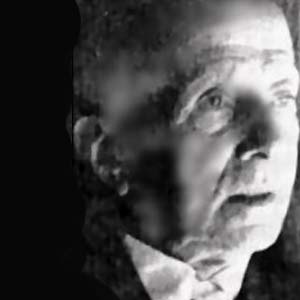
Henech Kon or Henryk Kon (1890–1972) was a Polish cabaret performer.
Kon was born in Łódź to a Chassidic family, and sent at the age of 12 to his grandfather in Kutno, where he studied Torah but also studied with local klezmers, absorbing folk music from players and badkhonim. When his family realized he would never be a rabbi, they sent him to music school in Berlin.
In 1912 he returned to Poland where he was drawn into literary artistic circles of Jewish Warsaw, particularly the “artistic culture salon” of the famous Polish actress Tea Artsishevska (née Miryam Isroels), later a member of the revi-teater Azazel. Her then husband, sculptor Bernard Kratko, introduced Kon to Isaac Leib Peretz and Kon set several of Peretz’s works to music, including Treyst mayn folk (Comfort My People) and the play Bay nakht oyfn alten mark (A Night in the Old Marketplace).
In 1922 “proletarian Lodz was tired of earnest dramas and light comedies.” Responding to the new popularity of satire, Kon – with poet Moishe Broderzon and painter Yitschok Broyner – created the marionette theater Chad-Gadya, the first of a string of revi-teaters (venues for music theater revues) in Polish towns and cities.
Henekh Kon was Moyshe Broderson’s closest collaborator, building with him all the kleynkunst theaters in Poland: the marionette-theater Khad-Gadye (1922) in Lodz, the kleynkunst theater Azazel (1925) in Warsaw, Sambatiyon (1926) and Ararat (1927). His was the musical spirit behind all of them.
He later was also closely associated with the kleynkunst (small art) venue Ararat. He composed music for around 40 theater productions, including Sholem Asch’s Kiddush ha-Shem, Shakespeare’s Shylock, Aaron Zeitlin’s (Tseytlin’s) Yidnshtot, Moshe Lipshitz’ Hershele Ostropolyer, Dovid Bergelson’s Di broytmil (The Bread Mill), H. Leyvik’s Der Golem, and many others.
His opera David and Batsheba was written (with Moishe Broderzon) and presented in Warsaw in 1924. Kon himself sang in the production, as did Moshe Shneur’s chorus.
He is strongly associated with the Warsaw Yung-teater, the Yiddish avant-garde theater company which emerged from Michal Weichert’s Yiddish Theater Studio. He wrote the music for Boston, about Sacco and Vanzetti, Trupe Tanentzap, an Abraham Goldfaden spectacle, Napoleon’s Treasure, based on a Sholem Aleichem story, and many others.
After the Second World War Henoch Kon worked with the Yiddish Art Theater in Paris. Beginning in 1934 he also worked in film; he composed the music for The Dibbuk and Zygmunt Turkow’s Di freylekhe kabtsonim (The Jolly Paupers), among others. He moved to America, where he was never particularly successful, and died in New York City.
12 thoughts on “Kaminos”
Was Nicholas related to Alexander Saslavsky who married Celeste Izolee Todd?
Anyone have a contact email for Yair Klinger or link to score for Ha-Bayta?
wish to have homeland concert video played on the big screen throughout North America.
can organize here in Santa Barbara California.
contacts for this needed and any ideas or suggestions welcomed.
Nat farber is my great grandpa 😊
Are there any movies or photos of max kletter? His wife’s sister was my stepmother, so I’m interested in seeing them and sharing them with his wife’s daughter.
The article says Sheb recorded his last song just 4 days before he died, but does not tell us the name of it. I be curious what it was. I’d like to hear it.
Would anyone happen to know where I can find a copy of the sheet music for a Gil Aldema Choral (SATB) arrangement for Naomi Shemer’s “Sheleg Al Iri”. (Snow on my Village)?
Joseph Smith
Kol Ram Community Choir, NYC
Shalom Joseph. I just saw your 2024 post by chance… I’m a mostly-retired Israeli journalist and translator. In 2003 I translated into English the content (the objective was to remain true to the meaning, not to cadence or rhyme) of poems and lyrics of 48 of Israel’s most iconic songs arranged by Aldema for choirs abroad singing in Hebrew (the words in the scores are transliterated) but members of the choir lack mastery of Hebrew to ‘know’ exactly what they are saying/singing… The book was titled in English “A Merry Choir” – in Hebrew מקהלה עליזה . See if you can find a copy in a used book store, it is priceless and apparently out-of-print – well worth the search. If not, they may have a copy at Tel Aviv Amenu Museum’s music department – write them and see if they can send it to you. Or – if you will contact me via Whatsapp – (972) 546872768 or via my email – I will try and find the book (it is not where it ‘should be’ so I have to search) and I will photograph the score with my cell and send to you as an attachment. Best, Daniella Ashkenazy – Kfar Warburg.
שלום שמעון!
לא שכחתי אותך. עזבתי את ישראל בפברואר 1998 כדי להביא את בני האוטיסט לקבל את העזרה המקצועית שלא הייתה קיימת אז בישראל. זה סיפור מאוד עצוב וטרגי, אבל אני הייתי היחיד עם ביצים שהביא אותו והייתי הורה יחיד בשבילו במשך חמישה חודשים. הוא היה אז בן 9. כעת הוא בן 36 ומתפקד באופן עצמאי. נתתי לו הזדמנות לעתיד נורמלי. בטח, אבות כולם חרא, אומרים הפמינציות, אבל כולם צריכים לעבוד כמטרות במטווחי רובה!
משה קונג
(Maurice King)
Thank you for this wonderful remembrance of Herman Zalis. My late father, Henry Wahrman, was one of his students. Note the correct spelling of his name for future reference. Thank you again for sharing this.
Tirza Wahrman (Mitlak)
amazing zchuso yagein aleinu, he wrote the famous niggun Lefichuch that is sung in almost every Israeli Yeshiva
My grandmother, Rose Ziperson, wrote the words to his music for a song called Main Shtetele, which he produced. I have the sheet music!