
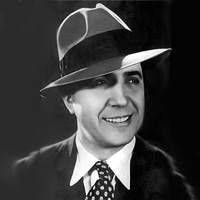
Carlos Gardel (11 December 1887/1890 – 24 June 1935 Medellín, Colombia) is perhaps the most prominent figure in the history of tango. Although his birthplace is disputed between Uruguay and France, he lived in Argentina from the age of two and acquired Argentine citizenship in 1923. He grew up in the Abasto neighbourhood of Buenos Aires, located near the Central Market of Fruit and Vegetables, an enormous art-deco styled building which today is a shopping mall. He attended Pio IX Industrial high-school located in the Almagro neighbourhood. He died in an airplane crash at the height of his career, becoming an archetypal tragic hero mourned throughout Latin America. For many, Gardel embodies the soul of the tango style that originated in the barrios of Buenos Aires at the end of the 19th century. He is commonly referred to as “Carlitos”, “The King of Tango”, “El Mago” (The Magician) and “El Mudo” (The Mute).
The unerring musicality of Gardel’s baritone voice and the dramatic phrasing of his lyrics made miniature masterpieces of his hundreds of three-minute tango recordings. Together with lyricist and long-time collaborator Alfredo Le Pera, Gardel wrote several classic tangos, most notably: Mi Buenos Aires querido, Cuesta abajo, Amores de estudiante, Soledad, Volver, Por una cabeza and El día que me quieras.
Gardel began his singing career in bars and at private parties, and sang with Francisco Martino and later in a trio with Martino and José Razzano. Gardel created the tango-canción in 1917 with his rendition of Pascual Contursi and Samuel Castriota’s Mi Noche Triste. The recording sold 10,000 copies and was a hit throughout Latin America.
Gardel went on tour through Argentina, Uruguay, Chile, Brazil, Puerto Rico, Venezuela, Colombia, and also made appearances in Paris, New York, Barcelona and Madrid. He sold 70,000 records in the first three months of a 1928 visit to Paris. As his popularity grew, he made a number of films for Paramount in France and the U.S. While sentimental films such as El día que me quieras and Cuesta abajo lack lasting dramatic value, they were outstanding showcases of his tremendous singing talents and moviestar looks.
In 1915 Carlos Gardel was supposedly wounded after being shot by Che Guevara’s father, Ernesto Guevara Lynch, as a result of a bar room brawl in the belle epoque Palais de Glace in the Recoleta district of Buenos Aires, although different versions assert that he was shot in the chest or in the leg, yet another variation holds that it was not Che’s father but rather Roberto Guevara, an upper-class boy often involved in quarrels.
Gardel died in 1935 on an airplane crash in Medellín, Colombia. Le Pera, two of their guitarists (Guillermo Desiderio Barbieri and Ángel Domingo Riverol) and several business associates and friends of the group died in the crash as well. It is believed that a third guitarist, José María Aguilar, died a few days after the crash. Others state that Aguilar lived until 1951, although he never regained full use of his hands and sight.
Millions of his fans throughout Latin America went into mourning. Hordes came to pay their respects as his body was taken from Colombia through New York and Rio de Janeiro. Thousands rendered homage during the two days he lay in state in Montevideo, the city in which his mother lived at the time. Gardel’s body was laid to rest in La Chacarita Cemetery in Buenos Aires. In the neighborhood of Abasto, Buenos Aires, in the house where Gardel lived with his mother, the Carlos Gardel Museum opened in 2003.
Gardel is still revered from Tokyo to Buenos Aires. A popular saying in Latin America, which serves as a testimony to his long-lived popularity, claims, “Gardel sings better every day.” The fingers of his life-sized tuxedo-clad statue on his tomb nearly always hold a burning cigarette left by an admirer. Another commonly used phrase in Latin America, which asserts that Veinte años no es nada (Twenty years is nothing), comes from his song Volver.
During 2009/2010 statues depicting Gardel are scheduled to be erected temporarily throughout twenty-five small villages and towns of Scotland, commemorating his tour of 1930 where the singer used funds from his well paid appearances in Glasgow and Edinburgh to subsidise small unannounced concerts in rural venues. These impromptu (and free) appearances endeared him to the working population of Scotland and his legacy of passion and art endure through regular commemorative concerts and amateur productions. However the tour is a stunt carried out by performing arts company Mischief La Bas.
Birthplace controversy
The place of Gardel’s birth is a matter of considerable controversy that still provokes passionate debate in Uruguay and Argentina.
During his life, Gardel declared in several occasions being Uruguayan, born in Tacuarembó. After his death, his legal representative, Armando Defino, produced a handwritten will, which he assured was written by Gardel himself, claiming he was born in Toulouse, France, to Berthe Gardès (1865-1943), and baptized with the name of Charles Romuald Gardes. It is not known who Gardel’s father was. Due to the fact that this will was officially considered authentic by the Argentinian law, Berthe Gardes (and, after her, Defino himself) received Gardel’s inheritance. There is an original birth certificate of a child born in Toulouse to Berthe Gardès on December 11th, 1890. There is no other evidence (except for the handwritten will) linking this child with the singer. The will was controversial due to the lack of previous notice that Gardel had any relationship with France whatsoever. He never declared or suggested that during his life.
A different line of research (Payssé González: “Gardel. Páginas Abiertas”, 1st. ed. Montevideo, 1990, 3rd. ed. Montevideo, 2002; Ostuni, “Repatriación de Gardel”, Buenos Aires, 1997; Bayardo, “Carlos Gardel: A La Luz De La Historia”, Montevideo, 2000) claims that Gardel was born Carlos Escayola Oliva in the rural estate (“estancia”) of Carlos Escayola Medina, in the Uruguayan department of Tacuarembó. Gardel obtained his first official identity document (“Constancia de nacionalidad”) in Buenos Aires on October 8th, 1920. There, Gardel claims being Uruguayan, born in Tacuarembó to “Carlos and María, deceased”. All the following official documents issued to Gardel certify he is Uruguayan. They can be seen here: http://www.montevideo-tango.com/mvdt/Gardel.htm. There is speculation that Gardel gave Tacuarembó as his birthplace to evade military service during World War I for his native France. Nevertheless, World War I ended in 1918, and this document was issued in 1920. It has been proven by Paysse Gonzalez (2002) and Bayardo (2000) that French law did not enforce military service to the sons of widows resident abroad.
When asked about his nationality, Gardel would repeatedly answer he was Uruguayan, born in Tacuarembó. To the periodical “El Telégrafo” (Paysandú, Uruguay, October 25th, 1933) he declared: “I’m Uruguayan, born in Tacuarembó” [“soy uruguayo, nacido en Tacuarembó”]. In June’s 1935 issue of “Caretas” magazine of Antioquia, Colombia, Gardel declared: “Mi heart is Argentinian, but my soul is Uruguayan, because there is where I was born“ [“Mi corazón es argentino, pero mi alma es uruguaya, porque allí nací”].
12 thoughts on “Kaminos”
Was Nicholas related to Alexander Saslavsky who married Celeste Izolee Todd?
Anyone have a contact email for Yair Klinger or link to score for Ha-Bayta?
wish to have homeland concert video played on the big screen throughout North America.
can organize here in Santa Barbara California.
contacts for this needed and any ideas or suggestions welcomed.
Nat farber is my great grandpa 😊
Are there any movies or photos of max kletter? His wife’s sister was my stepmother, so I’m interested in seeing them and sharing them with his wife’s daughter.
The article says Sheb recorded his last song just 4 days before he died, but does not tell us the name of it. I be curious what it was. I’d like to hear it.
Would anyone happen to know where I can find a copy of the sheet music for a Gil Aldema Choral (SATB) arrangement for Naomi Shemer’s “Sheleg Al Iri”. (Snow on my Village)?
Joseph Smith
Kol Ram Community Choir, NYC
Shalom Joseph. I just saw your 2024 post by chance… I’m a mostly-retired Israeli journalist and translator. In 2003 I translated into English the content (the objective was to remain true to the meaning, not to cadence or rhyme) of poems and lyrics of 48 of Israel’s most iconic songs arranged by Aldema for choirs abroad singing in Hebrew (the words in the scores are transliterated) but members of the choir lack mastery of Hebrew to ‘know’ exactly what they are saying/singing… The book was titled in English “A Merry Choir” – in Hebrew מקהלה עליזה . See if you can find a copy in a used book store, it is priceless and apparently out-of-print – well worth the search. If not, they may have a copy at Tel Aviv Amenu Museum’s music department – write them and see if they can send it to you. Or – if you will contact me via Whatsapp – (972) 546872768 or via my email – I will try and find the book (it is not where it ‘should be’ so I have to search) and I will photograph the score with my cell and send to you as an attachment. Best, Daniella Ashkenazy – Kfar Warburg.
שלום שמעון!
לא שכחתי אותך. עזבתי את ישראל בפברואר 1998 כדי להביא את בני האוטיסט לקבל את העזרה המקצועית שלא הייתה קיימת אז בישראל. זה סיפור מאוד עצוב וטרגי, אבל אני הייתי היחיד עם ביצים שהביא אותו והייתי הורה יחיד בשבילו במשך חמישה חודשים. הוא היה אז בן 9. כעת הוא בן 36 ומתפקד באופן עצמאי. נתתי לו הזדמנות לעתיד נורמלי. בטח, אבות כולם חרא, אומרים הפמינציות, אבל כולם צריכים לעבוד כמטרות במטווחי רובה!
משה קונג
(Maurice King)
Thank you for this wonderful remembrance of Herman Zalis. My late father, Henry Wahrman, was one of his students. Note the correct spelling of his name for future reference. Thank you again for sharing this.
Tirza Wahrman (Mitlak)
amazing zchuso yagein aleinu, he wrote the famous niggun Lefichuch that is sung in almost every Israeli Yeshiva
My grandmother, Rose Ziperson, wrote the words to his music for a song called Main Shtetele, which he produced. I have the sheet music!