
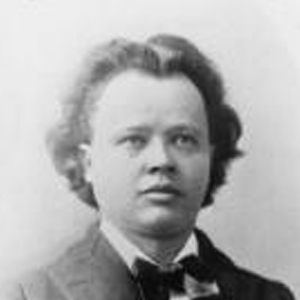
Edward Stark was born in 1856 in Hohenems, Austria to father Josef Stark, a local cantor and butcher. As a young boy, Edward sang in his father’s choir along with his three older brothers.
In 1871, Edward and his family immigrated to America to join the three eldest sons of the Stark family who had moved there in the early 1860’s. The Stark family settled in the German-Jewish community concentrated in the “East 50’s” of New York City, and Josef was hired to officiate at Congregation Adat Israel.
Edward worked for 20 years with his brothers in the clothing business, pursuing musical activities in his free time. In April of 1884, Stark married Rose Weinberger, and together they had four children. Stark was active in many associations, including the Germania Quartet Club, an amateur singing group. He composed several operettas for the group, such as “Germania, oder Traumbild eines Gesang-Vereins” (“Germania, or the Dream of a Singing Society”). Stark studied Hebrew and hazzanut with his father, and in November of 1885 traveled to Vienna and to Leipzig to study music formally.
In 1891, Stark accepted his first official cantorial position at Congregation Beth Elohim in Brooklyn, New York, a post he held for two years. In October of 1893, he was offered a position at Emanu-El, the largest Reform Synagogue in San Francisco. Emanu-El was one of the first synagogues to use the Union Prayer Book, and as such, Stark composed musical settings for most of the liturgy for their service. Many of these early arrangements were later included in his collection Sefer Anim Zmirot (1909-1913). Stark greatly increased the scope of Emanu-El’s choir, and was one of the first cantors to introduce instruments, aside from the organ, into the synagogue service. Only two of his works for choir and instruments have survived: “Memorial Hymn” (1895) and “Day of God” (1898).
Stark was aligned with the South German cantorial style, a tradition he inherited from his father, and from teachers in Europe. Stark advocated for the preservation of traditional nusach in the American Reform service. Most of his compositions included in Anim Zmirot utilize the adonai malakh and magen avot modes. Stark’s style was heavily influenced by the classical oratorio, and by the work of Salomon Sulzer and Louis Lewandowski. He continued to serve at Emanu-El until he fell ill in 1913, and was succeeded by Rueben Rinder. Stark spent his last years in San Francisco, and died in April of 1918.
12 thoughts on “Kaminos”
Was Nicholas related to Alexander Saslavsky who married Celeste Izolee Todd?
Anyone have a contact email for Yair Klinger or link to score for Ha-Bayta?
wish to have homeland concert video played on the big screen throughout North America.
can organize here in Santa Barbara California.
contacts for this needed and any ideas or suggestions welcomed.
Nat farber is my great grandpa 😊
Are there any movies or photos of max kletter? His wife’s sister was my stepmother, so I’m interested in seeing them and sharing them with his wife’s daughter.
The article says Sheb recorded his last song just 4 days before he died, but does not tell us the name of it. I be curious what it was. I’d like to hear it.
Would anyone happen to know where I can find a copy of the sheet music for a Gil Aldema Choral (SATB) arrangement for Naomi Shemer’s “Sheleg Al Iri”. (Snow on my Village)?
Joseph Smith
Kol Ram Community Choir, NYC
Shalom Joseph. I just saw your 2024 post by chance… I’m a mostly-retired Israeli journalist and translator. In 2003 I translated into English the content (the objective was to remain true to the meaning, not to cadence or rhyme) of poems and lyrics of 48 of Israel’s most iconic songs arranged by Aldema for choirs abroad singing in Hebrew (the words in the scores are transliterated) but members of the choir lack mastery of Hebrew to ‘know’ exactly what they are saying/singing… The book was titled in English “A Merry Choir” – in Hebrew מקהלה עליזה . See if you can find a copy in a used book store, it is priceless and apparently out-of-print – well worth the search. If not, they may have a copy at Tel Aviv Amenu Museum’s music department – write them and see if they can send it to you. Or – if you will contact me via Whatsapp – (972) 546872768 or via my email – I will try and find the book (it is not where it ‘should be’ so I have to search) and I will photograph the score with my cell and send to you as an attachment. Best, Daniella Ashkenazy – Kfar Warburg.
שלום שמעון!
לא שכחתי אותך. עזבתי את ישראל בפברואר 1998 כדי להביא את בני האוטיסט לקבל את העזרה המקצועית שלא הייתה קיימת אז בישראל. זה סיפור מאוד עצוב וטרגי, אבל אני הייתי היחיד עם ביצים שהביא אותו והייתי הורה יחיד בשבילו במשך חמישה חודשים. הוא היה אז בן 9. כעת הוא בן 36 ומתפקד באופן עצמאי. נתתי לו הזדמנות לעתיד נורמלי. בטח, אבות כולם חרא, אומרים הפמינציות, אבל כולם צריכים לעבוד כמטרות במטווחי רובה!
משה קונג
(Maurice King)
Thank you for this wonderful remembrance of Herman Zalis. My late father, Henry Wahrman, was one of his students. Note the correct spelling of his name for future reference. Thank you again for sharing this.
Tirza Wahrman (Mitlak)
amazing zchuso yagein aleinu, he wrote the famous niggun Lefichuch that is sung in almost every Israeli Yeshiva
My grandmother, Rose Ziperson, wrote the words to his music for a song called Main Shtetele, which he produced. I have the sheet music!